Identifying genetic abnormalities in embryos during in vitro fertilisation
Anil Biricik, Chief Scientific Officer IVF, Eurofins Genoma, biricik@laboratoriogenoma.it

Various social and demographic changes have contributed significantly to the increase in the average maternal age and infertility rates. For this reason, both Assisted Reproductive Techniques (ART) and Preimplantation Genetic Testing (PGT) have seen strong growth over the past two decades.
PGT analyses the cells collected by biopsy of the embryo’s trophectoderm to identify numerical (PGT-A) and structural (PGT-SR) chromosomal abnormalities and genetic variants (PGT-M). However, potential biopsy-related safety issues, operator-dependent variability, regulatory obstacles and the risk of embryo mosaicism, which can lead to false positive and negative results, are inherent features of PGT.
For this reason, a promising new approach for the detection of embryonic aneuploidies, called non-invasive PGT-A (niPGT-A), is emerging. niPGT-A analyses cell-free DNA (cfDNA) in the spent culture medium (SCM), in which the embryo is cultured without
the need for a biopsy. This reduces costs and partly overcomes the problem of mosaicism, as cfDNA in the SCM is released from both the trophectoderm and the inner cell mass.
Is it reliable and routinely applicable?
To answer this question, Eurofins Genoma, which hasbeen active in the PGT field for more than 20 years, conducted a clinical validation study on more than 500 SCM samples to understand which in vitro culture time is most effective for efficient cfDNA analysis, achieving a high ploidy concordance rate between SCM and biopsied trophectoderm samples.
Therefore, niPGT-A in association with morphological criteria is a useful tool to prioritise embryos for implantation without the need to manipulate them and without operator-dependent limitations. Indeed, in the presence of regulatory or technological restrictions that prevent embryonic biopsy, niPGT-A offers the possibility to all first and second level in vitro fertilisation
laboratories, which can benefit from a better evaluation than morphological analysis alone, to select the embryos with highest implantation potential with the less harmful method.
For more information, visit: www.laboratoriogenoma.eu
Deterministic container closure integrity testing – navigating the essential techniques
Leonard Harris, Manager, Chemistry & Container Testing, Eurofins Medical Device Testing, LeonardHarris@eurofinsUS.com
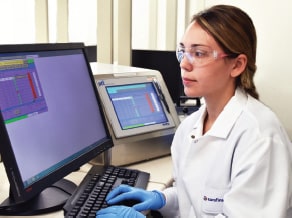
According to USP <1207>, container closure integrity testing refers to any package leak test (either physicochemical or microbiological) that detects the presence of a package breach or gap that would allow a product to escape or contamination to ingress. There has recently been a move away from traditional dye ingress testing towards methods that are more robust and able to detect smaller defects more reliably. There are many techniques available to test for container integrity, each with its own set of advantages and disadvantages. Understanding the strengths and weaknesses of each test is critical to developing a suitable method to ensure package integrity.
Helium Mass Spectrometry – Strengths: extremely small defects, packaging development, isolation of specific area of container, test frozen samples. Weaknesses: large molecules, permeable containers.
High Voltage Leak Detection (HVLD) – Strengths: non-destructive, good for large molecules, glass containers. Weaknesses: difficulty with defects at crimp seals for vials and needles and stoppers for pre-filled syringes, lyophilised products, plastic containers.
Vacuum Decay – Strengths: non-destructive, test flexible and rigid containers, bag and blister packs. Weaknesses: large molecules block defects, product must be able to withstand vacuum pressures, pre-filled syringes (silicone oil can block defects).
Oxygen Headspace – Strengths: fast, non-destructive, not affected by large molecules, lyophilised products, rigid containers packaged in low oxygen environment, cryo-vials stored at ultracold temperatures. Weaknesses: must have headspace in container, container must be transparent to IR light, product packaged in ambient oxygen environment.
Carbon Dioxide Headspace – Strengths: fast, non-destructive, don’t need modified packaging environment, carbon dioxide shipping studies, rigid containers, not affected by large molecules. Weaknesses: must have a headspace in container; transparent to IR light.
Choosing the correct technique for your product is paramount to successful CCIT. Using an experienced laboratory like Eurofins Medical Device Testing can help navigate the pitfalls that may arise during CCIT. For more information, visit: www.eurofins.com/biopharma-services/container-closure-integrity-testing
Eurofins BPT’s Global Councils collaborate to better serve clients
Jon S. Kauffman, PhD, Vice President, Biologics Testing, Eurofins BioPharma Product Testing US, jonkauffman@eurofins.com;
Elise Richard, Technical Committee Project Manager, Eurofins BioPharma Product Testing Europe, eliserichard@eurofins.com
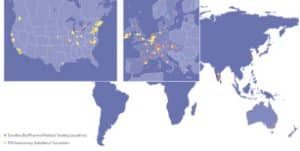
The Eurofins BioPharma Product Testing (EBPT) Global Technical Councils are comprised of Eurofins subject matter experts (SMEs) from sites across the US, EU and Asia. In 2022, the main active councils and sub councils/working groups held approximately 70 meetings, covering challenges affecting: Biologics (Biochromatography, Potency, Electrophoresis), Cell & Gene Therapy (ddPCR, Chromatography, Replication Competent Assays, Residual Impurities), Compendial, Microbiology, Qualified Persons (EU Only), Dissolution, Metrology, New Buildings, Medical Sevices (Consultancy, Chemical Characterisation).
These effective and valuable forums assemble SMEs to collaborate, harmonise, strategise and troubleshoot. The goal is building inter-laboratory relationships to share knowledge and experience across our extensive laboratory network. Councils have developed harmonised approaches and guidelines with regards to regulatory requirements (Annex 1 tool for gap analysis) and method transfers, and have drafted white papers, webinars and training materials. Another positive outcome is the ability to develop a strategy for investments and new method and service implementation as a result of identifying trends in the industry and new technologies at a global level.
Ultimately, these technical councils allow us to better serve our clients. Any site can bring forward an analytical or regulatory issue to the broader group, as an ideal troubleshooting platform. There is a high probability that another site has already faced a similar issue and can offer a quick resolution. For example, since the pandemic, an increased frequency of supply chain and quality issues have been observed with critical laboratory consumables (standards, kits, reagents and columns). In most situations, one EBPT laboratory has already encountered the same situation and can save the other EBPT laboratories valuable time by sharing root causes and offering suggestions and alternatives. This allows us to sustain support of our clients’ supply chain and provide their valuable products to the patients that need them. For more information, contact your Project Manager.
Eurofins Genomics US launches Express Oxford Nanopore Sequencing service with same-day results
James Corne, VP of Marketing, Eurofins Genomics, JamesCorne@eurofins.com

Eurofins Genomics US recently launched a revolutionary new, low-cost, whole plasmid sequencing service with same-day results. By leveraging Gen3 NGS (next generation sequencing) technology, this new service delivers a single-base accuracy of up to 99%.
Eurofins Genomics US is already a major competitor in the Sanger sequencing space, with a massive sequencing infrastructure in Louisville, Kentucky. In addition, it is a significate global player in the NGS space. The new service, Whole Plasmid Sequencing, seeks to close the gap between Sanger and NGS by offering an affordable, fast solution for long-read sequencing.
Pros and cons of NGS Sequencing
It is hard to overstate the impact that next generation sequencing (NGS) has had over the past few decades. Deep sequencing has paved the way for personalised medicine and evolutionary studies into infectious diseases, genetic disorders, and cancer. However, conventional NGS sequencing remains relatively slow and cost-prohibitive, despite a precipitous decrease in consumable and equipment cost over time. Furthermore, NGS requires significant time and effort to analyse and interpret the results. Although NGS has opened up a new world of possibilities, many laboratories simply do not have the resources or budget to effectively use the technology. In this sense, NGS overshot the needs of routine sequencing.
Pros and cons of Sanger Sequencing
Sanger, commonly referred to as “short read” or single molecule-based sequencing, is still the gold standard for sequencing, with 99.99% accuracy. Turnaround time is also extremely fast. However, the Sanger method only sequences a single DNA fragment at a time, which makes it cumbersome to verify long plasmids. Furthermore, it does not offer the same depth and versatility as newer technologies.
Advantages of Whole Plasmid Sequencing
Although Sanger and NGS both have pros and cons, many researchers find themselves choosing between too little or too much when it comes to sequencing. Whole Plasmid Sequencing combines the best of both methods. By fusing Gen3 NGS technology with internally developed methods, it offers more affordable, faster, long-read sequencing. Located next to the UPS hub for North America, Eurofins Genomics US leverages its logistical advantage to turn around results the same day that samples arrive. No primers or library preparation is required. Long constructs ranging from 2.5 to 300 kb are accepted. By leveraging Gen3 NGS technology and its logistical advantage, Eurofins Genomics opens up a new world of sequencing possibilities, for a fraction of the time and cost of conventional NGS. For more information, visit: www.eurofinsgenomics.com/en/products/whole-plasmid-sequencing/whole-plasmid-sequencing/
High-throughput screening for discovery of novel solid forms
Bahareh Khalili, PhD, Manager, Solid State Research & Development, Eurofins CDMO Alphora Inc., Bahareh.Khalili@bpt.eurofinsca.com

Polymorphism can be a major challenge in drug development. Late discovery of a more stable and less soluble polymorph at late development stages can severely impact patients and manufacturing costs.
Unfortunately, there is no reliable way of predicting the polymorphic landscape of active pharmaceutical ingredients (API) as of now. Although there has been numerous research done on computational prediction of the number of polymorphs, their solid structure, and characteristics, we are nowhere close to relying on these predictions. So, for now, empirical experimentation is the best tool for discovery and understanding API polymorphism.
When designing polymorph screening experiments, different parameters need to be considered. Combinations of different solvents/solvent mixtures with different crystallisation techniques and varying API concentrations can result in the formation of different polymorphs. Since predictions are not possible yet, the larger the number of trials, the higher the chance of discovering novel solid forms. That is why high-throughput screening (HTS) can be beneficial when exploring the polymorphic landscape of APIs.
The Eurofins CDMO Alphora team of solid state experts utilises high-throughput screening to maximise the chance of discovering new solid forms. Our HTS platform enables us to execute hundreds of crystallisation trials in parallel using a minimum amount of material. We explore several solvents/solvent mixtures and crystallisation techniques concurrently. High-throughput characterisation of the final solids makes it possible to identify novel crystalline forms that will then be prepared at a larger scale for complete physicochemical characterisation. A similar approach is also applied to the discovery of new salts and co-crystals, which are usually screened to improve the physicochemical properties of the API, such as solubility and stability.
This workflow allows us to explore common solvents with different techniques for crystallisation and gives us a good picture of the polymorphic landscape complexity. Depending on the results, more screenings may be designed, or the best solid form may be selected based on the physicochemical characteristics, solubility and stability. Performing these solid form screenings early on during development and selecting a suitable solid form is essential to the success of drug development and to avoid unpredicted challenges related to polymorphism at later stages. For more information, visit: www.eurofins.com/biopharma-services/cdmo/high-throughput-screening-for-discovery-of-novel-solid-forms/
Eurofins BioPharma Product Testing opens new site in China
Xin Yi, 易芯,Marketing Supervisor, Eurofins BioPharma Product Testing Shanghai, xin.yi@cpt.eurofinscn.com
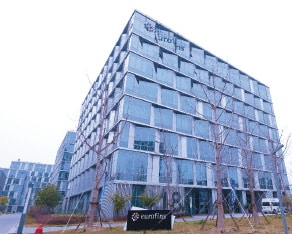
Eurofins BioPharma Product Testing is delighted to announce its first laboratory facility opening in Shanghai in March 2023, (Eurofins BPT Shanghai).
The Eurofins BPT Shanghai site has been under construction since 2021 and covers an area of approximately 2000 m². The laboratory construction was completed with the support of Eurofins’ European and US laboratories, using a globally harmonised LIMS, which meets the requirements of GMP regulations in China, the US and Europe. As the 40th GMP laboratory in the global Eurofins laboratory network, the Eurofins BPT Shanghai facility can provide safety testing services under GMP conditions for drugs and medical devices. Eurofins BPT Shanghai laboratory testing capabilities include:
- Cell Banking and Storage Service in a GMP Environment
- Cell/Virus Bank Characterisation
- Viral Clearance Validation
- Microbiological Testing
- Physical-Chemical Analysis
- Customised Method Development and Validation
Eurofins BPT Shanghai has well-trained experienced scientists who are experts on regulations spanning China, US, Europe and Japan. The team can also develop quick and stable testing methods based on global experience and client requirements. This ensures each product’s quality and safety and enables Chinese pharma customers to accelerate the process of product commercialisation overseas. For more information, visit: www.eurofins.cn/shanghai/